
Written 30th of March 2026
Key Message:
Recent events in the Middle East have increased uncertainty in financial markets. A key issue is the Strait of Hormuz, which is an important route for global oil shipments. If disruption continues, oil prices may stay higher for longer, which can affect inflation, interest rates and investment markets.
Why This Matters
Higher oil prices do not only affect fuel costs. They can also flow through to the wider economy and to investment markets.
- Petrol and energy costs can rise.
- Inflation can stay higher for longer.
- Interest rates may remain higher than expected.
- Bond Markets can come under pressure.
- Sharemarkets can become more volatile.
This is particularly relevant in the United States, where government debt is already high, and borrowing costs are sensitive to changes in both short-term and long-term interest rates.
The Key Concern for Investors
Our broader view is that ongoing conflict could create a more difficult environment for markets either way.
- If tensions ease, confidence in the current global financial system may still weaken over time, especially if more trade and energy payments continue to move away from the U.S. dollar.
- If tensions escalate, oil prices and bond yields could move higher, which may place further pressure on markets and economic growth.
- If central banks respond by adding more money into the financial system to calm markets, assets such as gold may benefit, even though short-term price moves can still be sharp.
In simple terms, geopolitical events can flow through quickly to inflation, interest rates and asset prices. Our current portfolio positioning has already been built with these risks in mind.
Has Our View on Gold Changed?
Our long-term view on gold has not changed. Despite recent price swings, we continue to regard gold as an important defensive holding in the current environment.
Gold has historically performed well during periods of:
- Geopolitical uncertainty
- Currency weakness
- Inflation concerns
- Stress in government debt markets
As a guide, we generally prefer clients to have at least 10% exposure to gold. That does not mean gold will move up in a straight line. It can still be volatile in the short term.
The graph below is included because it highlights an important point:
During periods of major monetary instability, gold can experience very large moves, but it can also be highly volatile along the way. The lesson is that trying to trade every short-term move can be difficult and often unhelpful.
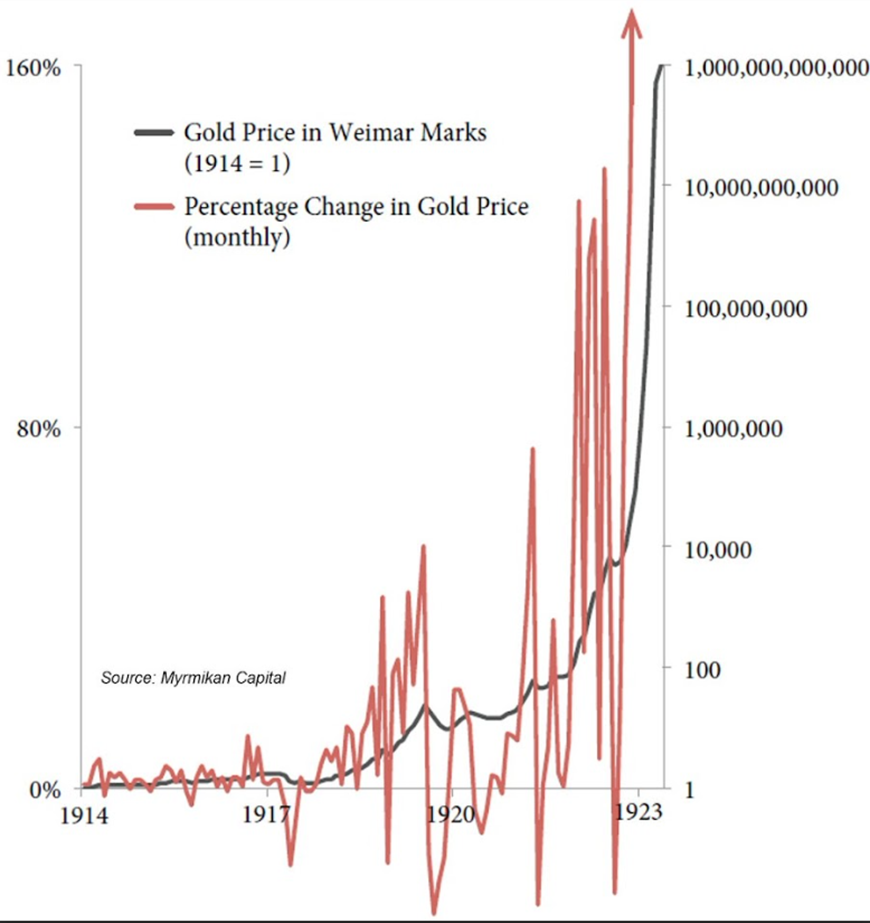
This graph shows how gold can rise strongly during a severe currency crisis, but with sharp swings along the way.
The Takeaway
Our long-term investment thesis remains intact. If anything, recent events have reinforced why we have taken a cautious and diversified approach. In our view, the West continues to spend money it does not have, and over time, that raises the risk of more money creation, higher inflation and pressure on interest rates.
For investors, the key message is not to react emotionally, but to stay focused on portfolio structure, liquidity and long-term positioning.
- Geopolitical events can affect portfolios indirectly through oil, inflation and interest rates, particularly in the short term.
- Shares and bonds can both come under pressure at the same time.
- We remain cautious in areas of the market where valuations are high, including U.S. technology shares and long-duration bonds.
- Diversification remains important, especially across assets that behave differently from each other.
- Defensive assets such as cash, fixed interest and gold can play an important role during uncertain periods.
We continue to review portfolio liquidity and overall risk settings carefully. If you would like to discuss how current market conditions may affect your portfolio, please contact our office to arrange a time with your adviser.
Written by Rob Coyte
CEO – Shartru Wealth