
In our previous blog, we looked at the quantum of US debt and who owned it.
https://www.shartruwealth.com.au/us-debt-how-much-and-who/
We also looked at the fact that US Debt now exceeded spending on the military budget which according to economist Nial Ferguson was an indicator of a falling Empire.
Federal spending increased from $6.4 trillion in FY 2023 to $6.8 trillion in FY 2024.
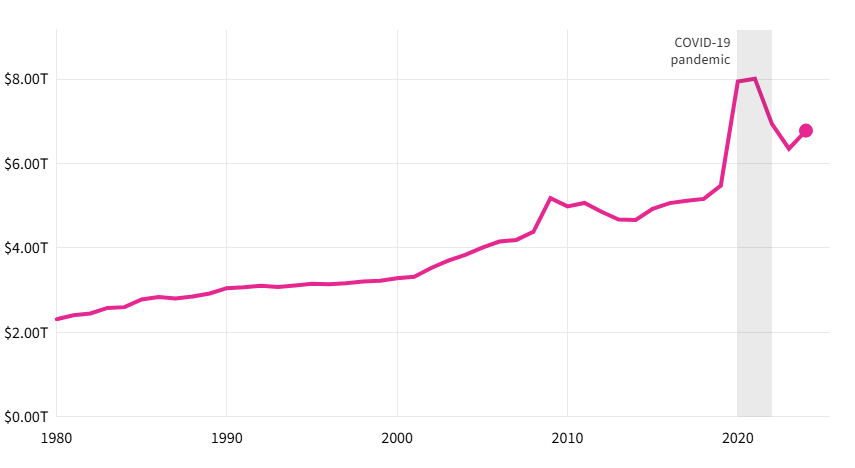
Source – USA Facts website
After the election of Donald Trump much has been said about trying to reduce the US debt. The first part of this is to not run a yearly deficit which increases the size of the existing debt. The most high-profile initiative has been Elon Musk being appointed to DOGE to stop wasteful government spending. Whilst it makes for good television to have press conferences highlighting the cancelling of dubious programs that cost the taxpayers millions will it actually make a difference?
In this blog, we are going to break down the US Government expenses to see if it is realistically possible to get the budget to break even or even surplus.
Let’s assume that the US government will earn $5 Trillion in receipts from all sources.
Currently, the US Government spends roughly the following percentage of its budget on the following;
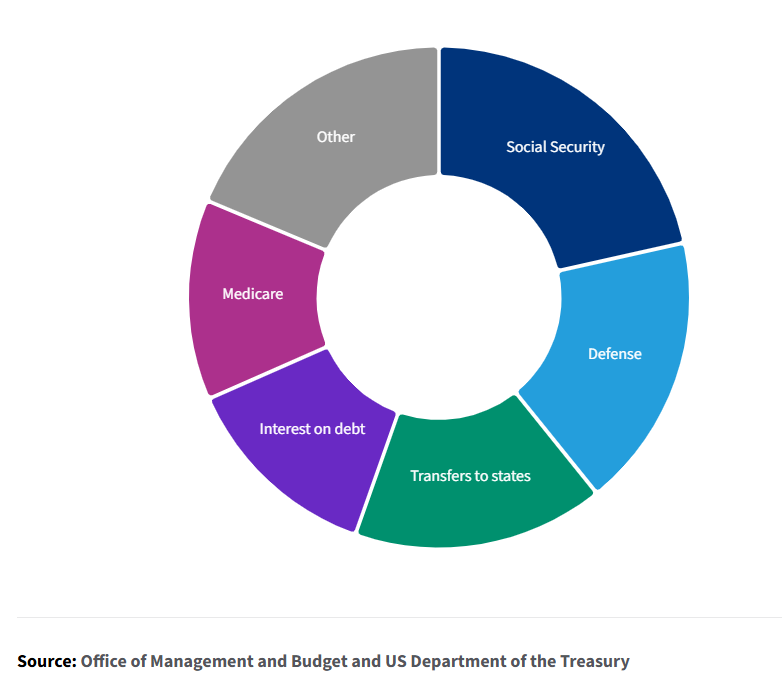
Put another way it looks like this
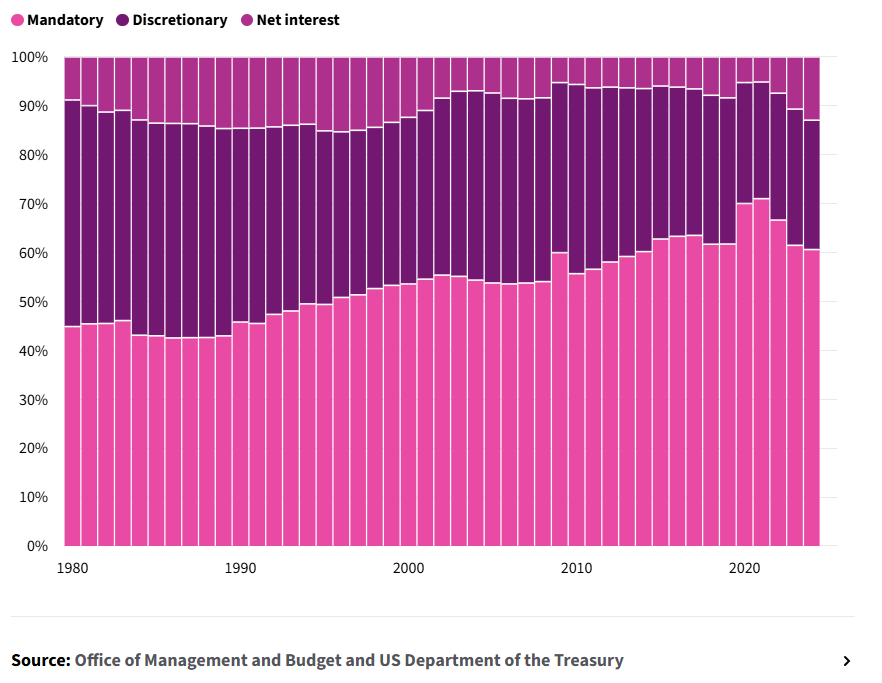
Therefore, assuming that the revenue of the US Government is not going to rise then we need to reduce expenses.
Let’s look at where this may be achieved or more importantly where this cannot be achieved so we can determine what is actually practically doable to reduce the deficit.
- Interest – determined by the market interest rates. As debt is refinanced it will be subject to the prevailing interest rate. Note this year there is about USD $6.5 Trillion of debt that needs to be refinanced (bonds need to be rolled) that will be reset at current interest rates (noting previous interest rates were lower).
- Defence – Is cutting military spending really an issue with the current events in Gazal, Ukraine and continued “tough talk” between China and the US?
- Medicare – This directly impacts people/voters
- Social Security – This directly impacts people/voters
As pointed out by Luke Gromen in his research with Forest For The Trees (which we highly recommend people interested in the macro world subscribe to).
“Health and Human Services is now annualizing at USD $1.8T annually; Social Security at USD $1.54T annually; Gross Interest at USD $1.4T annually; and Veterans Affairs at USD $400B annually”.
Politically and practically can they decrease spending in these areas?
For our purposes let’s assume that Defence spending comes in at USD $ 1 Trillion.
This means these expenses would add up to USD $6.14 Trillion against USD $5 Trillion worth of revenue.
Therefore, these expenses alone are more than the total revenue of the US Government and that is before we include other “discretionary” type expenses which comprised about 30% of spending last year.
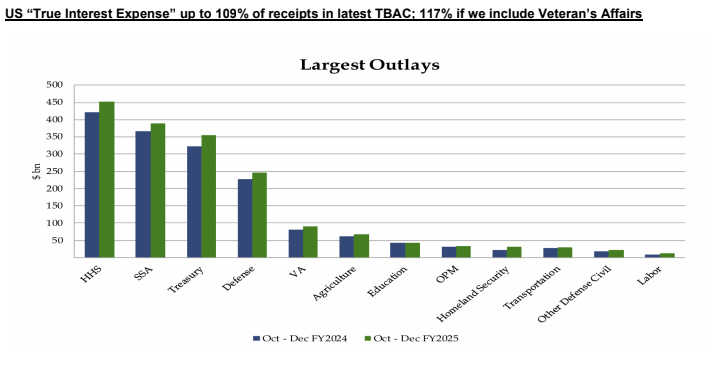
Source – FFT
This type of analysis is done based on expectations of “normality”. These costs will blow out further if amongst other things the following occurs;
- Interest rates continue to rise.
- The war escalates involving US involvement.
We don’t think it’s politically or practically possible to reduce the big ticket expenses in the US Government budget with the exception of interest, which is driven by the market. Our view is that interest rates will be heading higher over the medium to long term due in no small part to the structure of this budget deficit and the unwillingness of foreigners and investors to own US Government debt. If we are right in our above analysis this leaves very little scope to reduce the size of the US budget deficit.
In short, DOGE might make for good television and good politics but it doesn’t change the end game.
Article by: Rob Coyte, CEO, Shartru Wealth Management