
Executive Summary:
- The Micro-Licensee Trend: Solo and duo advisory firms now make up 54.8% of the market as advisers seek independence and autonomy.
- The AFSL Financial Burden: Securing and holding an Australian Financial Services Licence (AFSL) requires significant upfront capital, high software costs and mandatory $2 million minimum Professional Indemnity (PI) insurance.
- The ASIC Compliance Load: Self-licensed advisers assume 100% of the regulatory risk, bearing the full administrative weight of breach reporting, IDR data management and constant compliance updates.
- The Opportunity Cost: Every hour spent acting as a firm’s internal compliance officer or managing an Approved Product List (APL) is an hour lost to revenue-generating client strategy.
- The Shartru Wealth Alternative: Shartru Wealth Management offers a flat-fee dealer group model that removes the AFSL operational and compliance burden, allowing advisers to retain their independence without the administrative burnout.
Autonomy, control and equity drive many Australian financial advisers to establish their own AFSL. Self-licensing is appealing, but tighter regulation is changing what independence actually means in practice.
The solo and duo adviser firm now dominates the Australian market. According to Wealth Data, 54.8% of licensees currently operate with just one or two advisers.
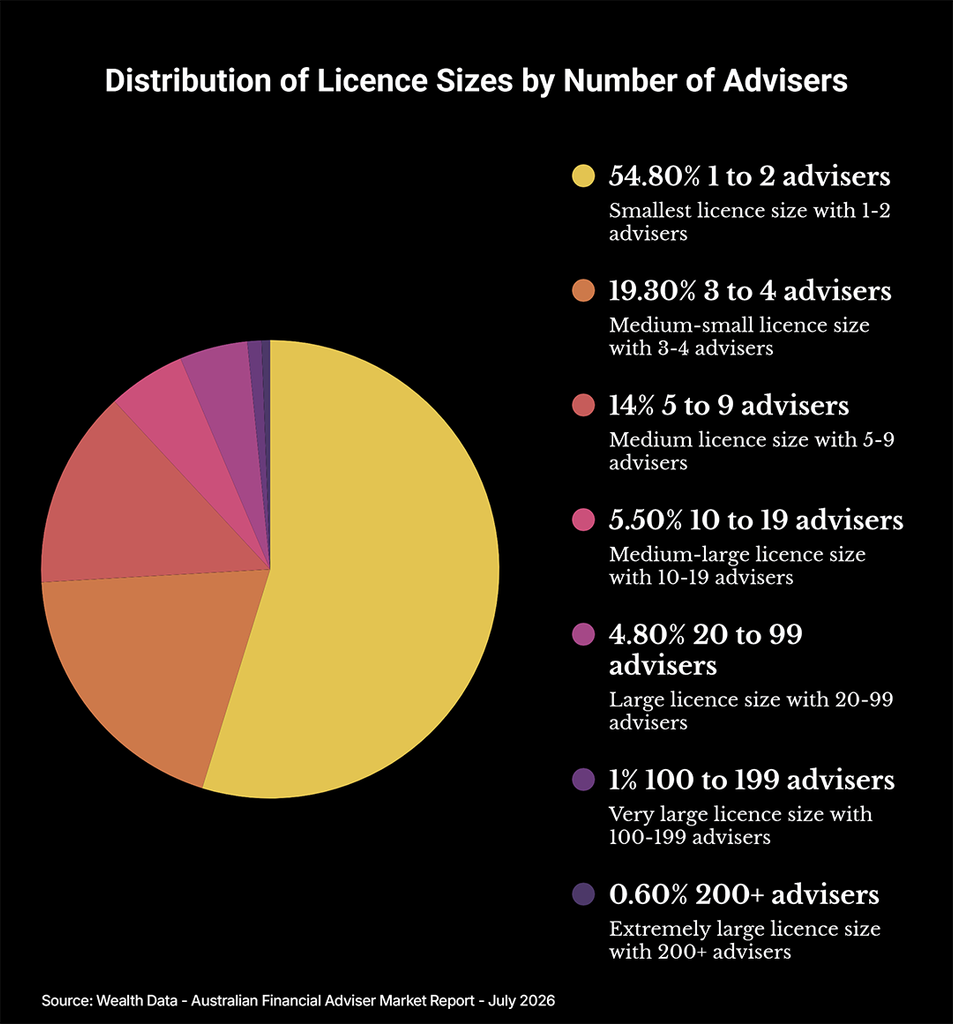
Advisers are clearly eager to escape traditional oversight to run their own boutique AFSLs. The catch is the heavy price tag attached to that independence. By dropping the rigid corporate constraints, these small practices inherit total regulatory accountability and a massive operational workload.
Whether you already operate under your own AFSL or plan to secure one, standing alone in 2026 requires a good look at the numbers.
The True Cost of Maintaining an AFSL in 2026
The financial burden of maintaining an AFSL extends far beyond the initial application. Advisers must navigate significant upfront capital and relentless ongoing overheads.
- Upfront Capital: The upfront costs are steep. Before opening their doors, advisers must fund legal consultants and ASIC application fees. On top of that comes the expense of building or sourcing fully compliant IT systems.
- Ongoing Overheads: The real financial pressure hits after the license is granted, ongoing expenses are relentless. Licensees have to fund mandatory Professional Indemnity (PI) insurance, which requires a minimum $2 million limit for retail client practices. Then come the annual AFSL audits. Combine those with ASIC levies, complex financial accounting bills and a heavy stack of software subscriptions – the true cost of independence becomes more clear.
ASIC Compliance and AFSL Regulatory Burdens
Holding an AFSL strips away the buffer between you and the regulator. Direct accountability to ASIC brings a regulatory load.
- Direct Accountability to ASIC: Self-licensed advisers carry the entire compliance burden. You are solely accountable for adhering to the Corporations Act and all related regulations. You become the risk manager and the compliance officer for your firm.
- Complex Reporting Obligations: Self-licensed advisers face mandatory reporting regimes without any backup. You are entirely on the hook for lodging breach reports and managing Internal Dispute Resolution (IDR) data. Add in the requirements to enforce strict ASIC reference checking protocols and constantly update the Financial Advisers Register (FAR) and the administrative workload starts to add up.
The Operational Burden of Self-Licensing
Perhaps the most significant cost of self-licensing is the opportunity cost.
Why did you become an adviser? Likely to help clients, not to manage administration.
- Reduced Client Time: Running an AFSL drains your most valuable asset: time. Every hour spent supervising staff, updating registers and monitoring compliance is an hour stolen from revenue-generating client work. Before long, back-office administration simply consumes the practice.
- Keeping Up with Regulatory Changes: Constant regulatory updates demand serious manpower. Practices usually face an expensive choice: carry the permanent payroll of an in-house compliance team or pay premium rates for outside consultants.
There is a Better Alternative to Self-Licensing
True independence does not require managing an AFSL. You can maintain absolute control over your business without carrying the operational weight of a license.
At Shartru Wealth Management, we offer a platform built by advisers, for advisers. Reputation is a shared asset. We protect yours with a compliance system built for the real world, keeping your practice secure without burying you in paperwork.
Why Partner with Shartru Wealth?
- Flat Fee Structure: Gain total financial certainty. Unlike percentage-based models that penalise your success, our flat annual fee ensures your costs remain stable, allowing you to retain more of your hard-earned revenue.
- True Independence: Operate within a boutique AFSL environment completely free from the influence of institutional product providers. Our APL is curated based on quality and merit, not institutional ties.
- Comprehensive Support: Our team handles your licensing, delivers your training and runs an efficient compliance program. We also provide continuous access to advice resources through our adviser portal.
- Reclaim Your Time: Let us take on that time you currently spend on licence oversight. Redirect that time back into your clients and growing your business.
Stop managing a licence. Start managing futures.
If the cost, compliance and administrative burden of self-licensing is holding your practice back, it’s time to talk. Discover how Shartru Wealth’s flat-fee model can give you the support of a major dealer group with the independence you need.
Ready to see the difference?
Let’s schedule a brief, no-obligation chat to see if our infrastructure is the right fit for your practice.
We will discuss:
| → | Your specific practice challenges and compliance roadblocks |
| → | How our adviser-built, flat-fee framework operates |
| → | Whether our network aligns with your future growth goals |
This information is general advice and does not take account of investors’ objectives, financial situation or needs. Before acting on this general advice, investors should therefore consider the appropriateness of the advice having regard to their objectives, financial situation or needs.

Written by Catherine Huff
General Manager – Shartru Wealth