
Artificial Intelligence (AI) may transform the economy; that does not mean every AI-related investment is attractively priced.
AI will change how businesses operate, reduce costs and potentially create entirely new industries – we do not dispute that potential. However, a good technology does not automatically make every company connected to it a good investment.
Our portfolios are underweight AI and technology compared with the benchmark. This means we still have exposure, but we hold less than an index that is now heavily concentrated in a small group of large technology companies. Our caution is based on the price investors are paying, the amount of money being spent and the uncertainty over who will ultimately earn an adequate return.
Underweight means less exposure than the benchmark – not no exposure.
The AI build-out is becoming extremely expensive.
The largest technology companies are spending enormous sums on data centres, computer chips, networking equipment and electricity infrastructure. Some of this spending is now being funded through greater debt issuance and complex financing arrangements.
These companies generally have strong balance sheets. The concern is not that they are about to run out of money. The issue is whether the next hundreds of billions of dollars invested in AI will earn returns high enough to justify the cost.
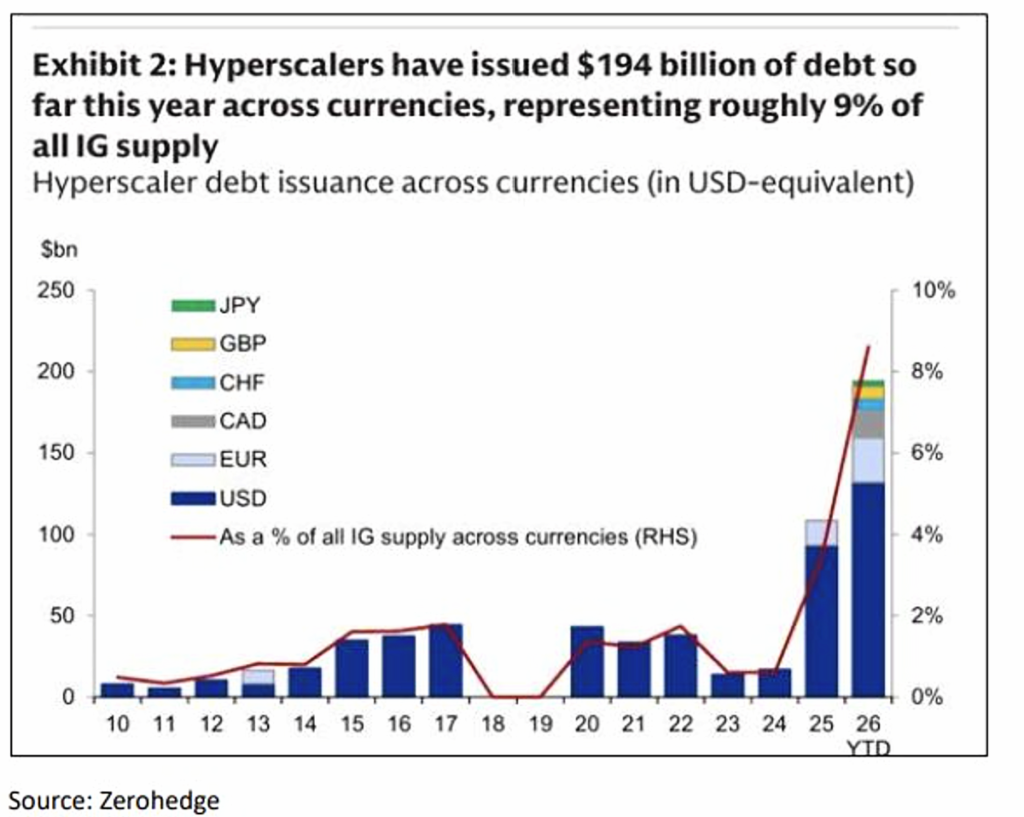
A data centre can be expected to operate for many years, but the technology inside it can become outdated quickly. Companies are therefore making long-term investments based on demand and pricing that may only be visible for the next year or two.
Less cash is being returned to Shareholders.
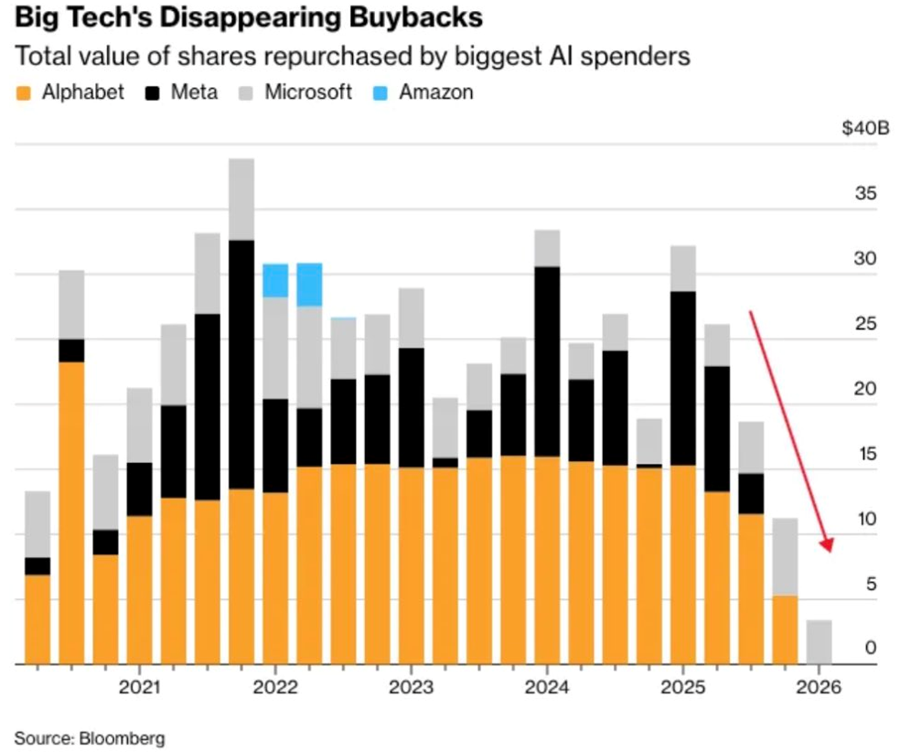
The major technology companies have historically used share buybacks to return excess cash to investors. Buybacks reduce the number of shares on issue and can support earnings per share.
Recent data suggest that the largest AI spenders are reducing buybacks as more cash is redirected into AI infrastructure. This does not mean the spending will fail. It does mean shareholders are giving up an immediate and relatively certain benefit in exchange for future returns that are harder to estimate.
Competition could push prices lower.
The current market value of many US technology companies assumes they will keep strong pricing power. That may be difficult if AI models become easier to replace and cheaper alternatives continue to improve.
Usage data from OpenRouter shows that Chinese-developed models have achieved considerable share among US businesses using that platform. These models can be cheaper and, in some cases, open source. Businesses may be able to run them on their own systems, adapt them to private data and avoid paying high ongoing fees to one provider.
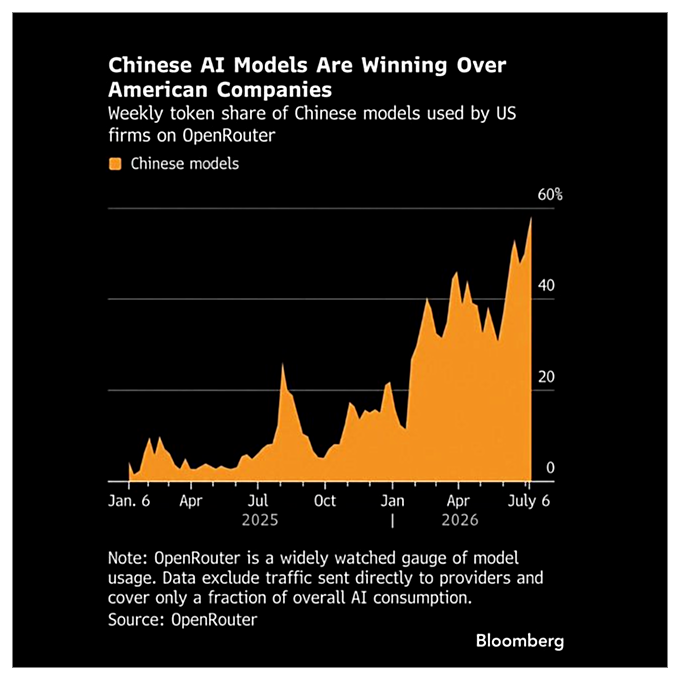
A business does not need the most advanced model for every task. It may choose a model that is slightly less capable but far cheaper. If customers can move easily between providers, prices and profit margins are likely to come under pressure.
AI could therefore become widely used while much of the financial benefit goes to customers rather than the companies building the models.
Reported profits may not yet reflect the full cost.
Another concern is the timing of expenses. Equipment and data centres that are still being built are generally recorded as “construction in progress”. Depreciation often does not begin until the assets are ready for use.
This is normal accounting, but it can create a gap between reported profit and economic reality. Computer chips may be ageing or becoming outdated before their full cost appears in the profit and loss statement. The current earnings may therefore look stronger than the long-term economics of the investment.
Why we remain underweight.
Our position is not based on a view that AI will disappear or fail. We expect AI to become an important part of the economy. Our concern is that current share prices already assume a great deal of future success.
For today’s valuations to be justified, several things must go right:
- AI demand must continue growing rapidly.
- The large spending programs must produce strong profits.
- Technology must not become outdated too quickly.
- Competition must not force prices and margins sharply lower.
- Investors must continue funding the build-out on attractive terms.
That is a demanding set of assumptions.
We prefer to keep some exposure while investing more heavily in areas where valuations are lower, competition is less intense and expected returns are not as dependent on distant promises.
Being underweight is not the same as being against AI. It is a decision to separate enthusiasm for the technology from discipline about the price paid for an investment.
This information is general advice and does not take account of investors’ objectives, financial situation or needs. Before acting on this general advice, investors should therefore consider the appropriateness of the advice having regard to their objectives, financial situation or needs.
Written by Rob Coyte
CEO – Shartru Wealth